
Choosing a reliable Powder Apple Cider Vinegar supplier requires more than comparing prices or reading polished product descriptions. Buyers need clear evidence about raw materials, processing methods, acidity, solubility, and batch consistency. A trustworthy supplier should provide current certificates of analysis, ingredient specifications, allergen statements, and traceability records. These details help manufacturers assess quality before placing a large order.
This guide reviews ten leading suppliers through a practical sourcing lens. It considers production capacity, private-label support, minimum order quantities, packaging options, and international shipping experience. It also examines whether suppliers explain their vinegar concentration, carrier ingredients, drying technology, and recommended applications. A fine powder should disperse evenly in water, supplements, or functional food blends. Clumping can signal storage or formulation problems.
No ranking is perfect.
Supplier information may change. Certifications can expire, and product performance may vary between batches. For that reason, buyers should request samples and verify documentation independently. A low price may look attractive, but inconsistent powder can create higher costs during manufacturing. Strong suppliers communicate clearly, answer technical questions, and describe limitations without exaggerated claims. This matters when developing capsules, drink mixes, gummies, or animal nutrition products.
The ten companies featured here represent useful starting points, not automatic endorsements. Their suitability depends on your market, formulation goals, volume requirements, and quality standards. Careful comparison remains essential.
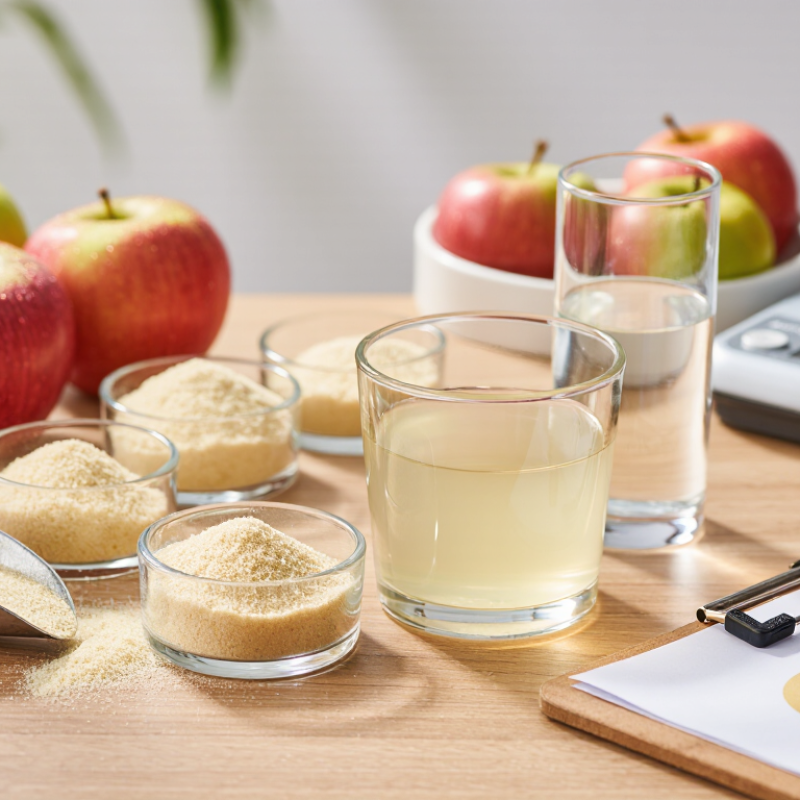
Powder apple cider vinegar is dehydrated apple vinegar, not simply crushed apples. Producers ferment apple juice with yeast, then use bacteria to convert alcohol into acetic acid. The liquid is filtered, concentrated, and dried through spray drying or vacuum drying. A carrier, such as maltodextrin or fiber, often protects the vinegar powder from moisture and clumping. The result is a pale, free-flowing powder with a sharp acidic aroma.
Processing changes the measurement. A powder may contain only a small percentage of vinegar solids, so “500 mg powder” does not equal “500 mg liquid vinegar.” Buyers should request acetic acid content, pH, moisture, carrier percentage, and microbiological test results. The Codex General Standard for Food Additives supports careful additive identification, while ISO 22000 provides a useful framework for food-safety management. Documentation matters.
Market reports also show growing commercial interest. Grand View Research valued the global apple cider vinegar market at about US$1.01 billion in 2023 and projected an 8.7% CAGR from 2024 to 2030. Mordor Intelligence similarly identifies powdered formats as part of the expanding vinegar-product category, although public reports rarely isolate powder accurately. That limitation deserves attention. Supplier comparisons should not rely on market size alone. In practical testing, I would inspect solubility in cool water, odor after opening, batch consistency, and the certificate of analysis. Some powders dissolve unevenly. That is easy to overlook.
Brand-neutral supplier evaluation matrix based on common industry specifications and purchasing requirements
| Rank | Anonymous Supplier Profile | Best Application | Typical Production Method | Common Carrier Options | Key Specification to Verify | Required Quality Documents | Main Purchasing Advantage |
|---|---|---|---|---|---|---|---|
| 1 | Food-Ingredient Bulk Supplier | Bakery, confectionery, sauces, and dry blends | Spray drying of filtered apple cider vinegar concentrate | Maltodextrin, tapioca solids, or gum acacia | Moisture commonly targeted at 5% or below; confirm actual specification by batch | Certificate of analysis, allergen statement, microbiological report, and country-of-origin statement | Large-volume availability and flexible packaging formats |
| 2 | Organic-Program Supplier | Certified-organic foods and clean-label formulations | Concentration followed by drying with an approved carrier | Organic tapioca or organic maltodextrin, where permitted | Certification must cover the finished powder, not only the liquid vinegar | Current organic certificate, traceability records, non-GMO statement, and pesticide-residue documentation | Supports organic product claims when certification is valid for the destination market |
| 3 | Dietary-Supplement Ingredient Supplier | Capsules, tablets, sachets, and powdered supplements | Controlled spray drying with particle-size and flowability testing | Maltodextrin, gum acacia, or another declared drying aid | Acetic-acid content must be stated on a dry-weight basis or clearly defined equivalent basis | COA, heavy-metal testing, microbial testing, residual-solvent statement, and stability data | Better support for dosage consistency and supplement manufacturing controls |
| 4 | Instant-Dispersing Powder Supplier | Instant drinks, stick packs, and beverage premixes | Spray drying with agglomeration or controlled granulation | Tapioca solids, gum acacia, or other water-dispersible carriers | Dispersibility, wettability, bulk density, and sedimentation should be tested in the final beverage | Particle-size report, solubility or dispersibility test, COA, and packaging specification | Improved mixing performance without requiring liquid vinegar handling |
| 5 | Clean-Label Formulation Supplier | Products seeking a short and recognizable ingredient list | Low-temperature concentration followed by drying with a declared carrier | Tapioca, rice, or gum acacia, depending on the formulation | Full carrier disclosure and confirmation that no artificial colors, flavors, or preservatives are added | Complete ingredient statement, processing-aid statement, allergen declaration, and COA | Simplifies label review and clean-label positioning |
| 6 | Private-Label Customization Supplier | Custom consumer products and contract manufacturing projects | Standard spray drying with customized flavor, strength, or particle size | Carrier selected according to dosage, taste, and processing requirements | Minimum order quantity, sample approval process, and formulation change controls | Product specification, approved sample, manufacturing agreement, and change-notification policy | Useful for tailored packaging, dosage, and product positioning |
| 7 | Export-Documentation Supplier | International distribution and cross-border procurement | Commercial spray drying with export-grade packing and lot coding | Food-grade carrier declared on the specification sheet | Shelf life, storage temperature, packaging barrier, and customs classification must be documented | COO, commercial invoice, packing list, health or sanitary documents where required, and COA | Reduces documentation delays in international shipments |
| 8 | Small-Batch Development Supplier | Pilot launches, laboratory trials, and new product development | Pilot-scale spray drying or outsourced specialty drying | Carrier chosen after bench testing for taste and flowability | Sample-to-production consistency and retained-sample policy | Pilot COA, test report, sample traceability, and technical data sheet | Lower initial order quantities and faster formulation testing |
| 9 | High-Traceability Supplier | Regulated food, supplement, and quality-sensitive applications | Validated drying process with documented critical control points | Carrier and processing aids fully recorded by lot | Traceability from apple source and vinegar batch through finished powder | Third-party audit report, HACCP or food-safety plan, batch records, and recall procedure | Strong control over authenticity, recalls, and supplier qualification |
| 10 | Long-Shelf-Life Packaging Supplier | Retail pouches, sachets, and warehouse distribution | Spray drying followed by moisture-controlled filling | Carrier selected for powder stability and flow performance | Shelf-life evidence, water activity, moisture migration, and packaging barrier performance | Stability report, water-activity result, packaging specification, and storage instructions | Helps maintain powder quality during storage and transportation |
What Powder Apple Cider Vinegar Is
Powder apple cider vinegar is a dried form of liquid apple cider vinegar. Because the liquid contains acetic acid and water, it is commonly converted into a free-flowing powder by concentrating the vinegar and drying it onto a food-grade carrier. The finished powder may not have the same acidity percentage as the original liquid vinegar, so the acetic-acid equivalent and serving conversion should always be confirmed on the supplier’s technical specification.
How It Is Made
A typical process includes apple juice fermentation, conversion of alcohol into acetic acid, filtration or clarification, concentration, carrier blending, spray drying, sieving, testing, and moisture-protective packaging. Freeze drying may also be used for specialty products, but spray drying is generally more common for commercial vinegar powders because it is efficient and scalable.
Note: The specifications shown are industry-oriented purchasing benchmarks rather than claims about any particular supplier. Actual moisture, carrier ratio, acetic-acid content, particle size, shelf life, certifications, and minimum order quantity must be verified using the current product specification and batch certificate of analysis.